

Truck tires
Wholesale commercial truck tires
Truck and bus radial tires exported from Asia to buyers in the USA and Canada.
Truck tires from 7 brands
Win Exports exports commercial truck tires from Asia to the USA and Canada. The brands we supply are Aeolus, Annaite, Seyoun, Constancy, Longmarch, ANSU, and Amberstone. Tell us the sizes, the axle positions and the quantities you need, plus where the tires are going, and we will reply with a quote. You can also ask for brake drums, brake chambers, lights and other truck parts in the same inquiry. Tires from different brands, and tires with truck parts, can be mixed in the same container load.
Tire positions: steer, drive, trailer and all-position
Truck tires are built for the axle they run on. These are the four position types you will see in a tire list. The tread illustrations are examples, not any manufacturer’s design.

Steer tires
Fitted to the steering axle at the front of a truck or tractor. They guide the vehicle, so even wear and stable handling matter most.

Drive tires
Fitted to the drive axles, where engine torque reaches the road. Drive tread designs are built for traction and wear under load.

Trailer tires
Fitted to trailer axles. They carry load and follow the tractor, so trailer tread designs focus on even wear and durability.

All-position tires
Designed to be used on any axle position. Always check the sidewall markings and the manufacturer’s guidance for the position you need.
Choosing the right truck tire
Four questions narrow down almost any tire list. Having the answers ready makes your quote request faster:
- Which axle position? Steer, drive, trailer or all-position. A tire built for one position is not always suitable for another.
- Which size and load range? Match the size and load range already on your vehicles, or the one your vehicle’s manufacturer specifies.
- How will it be used? Long-haul, regional, mixed service, or on rougher roads: the duty changes which tread design makes sense.
- Which brand? Tell us if you have a preferred brand, or describe the application and we can talk through the options from the brands we supply.
How to read a truck tire sidewall
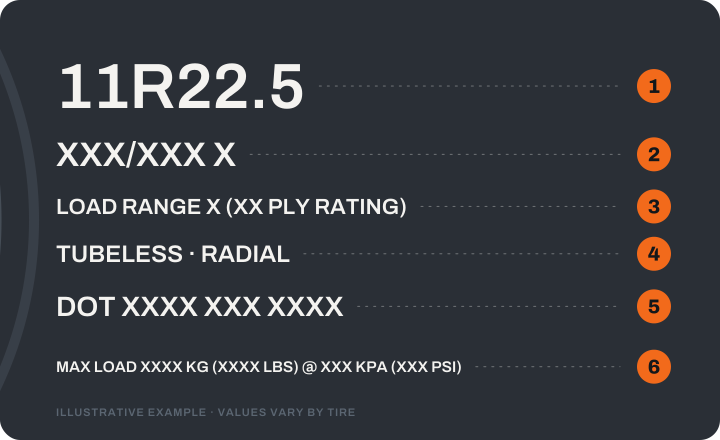
Every truck tire carries its key information on the sidewall. The diagram is an illustrative example; every value varies by tire, so always read the markings on the tire itself.
-
Size designation. The tire’s dimensions, such as 11R22.5 (section width in inches, R for radial construction, rim diameter in inches) or 295/75R22.5 (section width in millimeters, aspect ratio, radial, rim diameter in inches).
-
Load index and speed symbol. Many commercial tires show a load index (often two numbers, for single and dual fitment) followed by a speed symbol letter. Check the manufacturer’s data book for what they mean for your tire.
-
Load range and ply rating. A letter (such as G or H) that corresponds to a ply rating, an index of the tire’s strength. For example, load range G is a 14 ply rating and H is 16.
-
Construction. The words radial and tubeless (or tube type) are marked on the tire.
-
DOT code. The tire identification number: a plant code, a manufacturer’s code, and a four-digit date code giving the week and year of manufacture.
-
Maximum load and inflation pressure. Marked in both kg (lb) and kPa (psi), with the pressure stated as cold.
Full explanation, with sources: how to read a truck tire sidewall. More in our buying and import guides.
Tire brands we supply







Brand names and logos are trademarks of their respective owners.
Need truck tires quoted?
Tell us the tire sizes, parts and quantities you need. Call, text, WhatsApp or email and we reply with a quote.