

Published October 22, 2026
A commercial truck tire carries a lot of information on its sidewall. Knowing how to read it helps you order the right size, tell one load class from another, and see how old a tire is. This guide explains the common markings on truck and bus tires and where each one comes from.
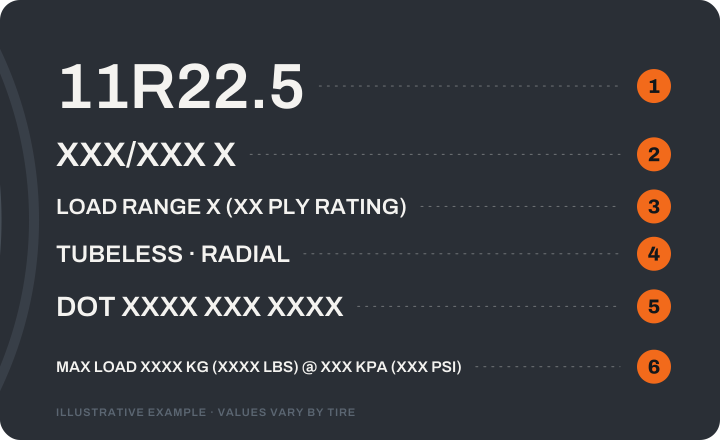
An illustrative example. Every value varies by tire, so an X stands for a value that depends on the tire. Always read the markings on the tire itself.
Where the markings come from
In the United States, Federal Motor Vehicle Safety Standard No. 119 sets the markings for tires on vehicles other than passenger cars, including tires for vehicles over 10,000 lb gross vehicle weight rating. Section S6.5 says each such tire must be marked on each sidewall with a list of items, labeled (a) to (j). Two of them, the DOT symbol and the tire identification number, may appear on only one sidewall. The numbered items below follow the diagram.
1. Size designation
The size designation must match a size published in the standards the regulation refers to. Two formats are common on truck tires:
- 11R22.5 is the older “numeric” format: 11 is the nominal section width in inches, R means radial construction, and 22.5 is the nominal rim diameter in inches.
- 295/75R22.5 is the metric format: 295 is the nominal section width in millimeters, 75 is the aspect ratio, R means radial, and 22.5 is the rim diameter in inches.
These definitions are from Toyo Tires’ commercial data book. For a side-by-side look at these two sizes, see 11R22.5 vs 295/75R22.5.
2. Load index and speed symbol
Many commercial tires also show a service description next to the size: a load index (often two numbers, for single and dual fitment) followed by a speed symbol letter. This is an industry marking rather than one of the items in FMVSS 119, and its meaning is set by the tire and rim standards bodies and the manufacturer. We have not cited a table here: use the manufacturer’s data book for the exact meaning of the numbers and letter on the tire you are buying.
3. Load range and ply rating
Toyo’s data book explains the two terms like this: ply rating “is an index of tire strength and does not necessarily represent the number of cord plies in the tire”, and “load range is merely a letter used to correspond with a ply rating.” Its table pairs them as follows:
| Load range | A | B | C | D | E | F | G | H | J | L | M | N |
|---|---|---|---|---|---|---|---|---|---|---|---|---|
| Ply rating | 2 | 4 | 6 | 8 | 10 | 12 | 14 | 16 | 18 | 20 | 22 | 24 |
So a tire marked load range G has a 14 ply rating, and load range H has a 16 ply rating. FMVSS 119 requires the load range letter to be marked, and also the actual number of plies and the ply cord material.
4. Construction
FMVSS 119 requires the word radial on a radial tire, the word tubeless or tube type, and the word regroovable if the tire is designed for regrooving.
5. DOT symbol and tire identification number
The DOT symbol certifies that the tire conforms to the applicable federal motor vehicle safety standards. Beside it is the tire identification number (TIN), defined in 49 CFR 574.5. On a new tire it is 13 symbols in three groups:
- a plant code of three symbols, which identifies the manufacturer’s plant,
- a manufacturer’s code of six symbols, and
- a date code of four digits.
The first two digits of the date code are the week and the last two are the last two digits of the year. The regulation’s own example is that “0109” means the tire was made in the first full calendar week of 2009. Weeks run from Sunday to Saturday. The date code tells you how old a tire is, so check it when you buy.
6. Maximum load and inflation pressure
FMVSS 119 requires the maximum load and the matching inflation pressure to be marked in both metric and US units, and to state that the pressure is cold. A tire rated for both single and dual use is marked in this form: “Max load single ___ kg (___ lb) at ___ kPa (___ psi) cold. Max load dual ___ kg (___ lb) at ___ kPa (___ psi) cold.” A tire with a speed restriction of 90 km/h (55 mph) or less must also show “Max speed ___ km/h (___ mph).”
Before you buy
- Match the size and load range to what your vehicle and axle position need (see steer, drive and trailer tires).
- Check the DOT code for the plant and the date of manufacture.
- Ask for the manufacturer’s data sheet for the exact tire, which gives the load and pressure figures for each size.
Looking for a specific size? See our truck tires or request a quote.
Sources
General information as of October 22, 2026, not legal or customs advice. Rules, duties and requirements change: confirm the current position with the official source or your customs broker.
- 49 CFR 571.119 (FMVSS No. 119), S6.5 Tire markings (Cornell Legal Information Institute; the official text is in the eCFR) (accessed October 22, 2026)
- 49 CFR 574.5 Tire identification requirements (Cornell Legal Information Institute; the official text is in the eCFR) (accessed October 22, 2026)
- Toyo Tires, 2024 Commercial Dimensions and Load Limits, “Tire size and dimension definitions” (PDF) (accessed October 22, 2026)